

Composable Commerce: What It Means and Is It Good for Your Product?
Business
22/12/25
Read time: 18 min
Intro
Imagine you’re building your dream home. You want every room to genuinely reflect who you are, showcasing your soul and character to visitors and friends. Beyond appearance alone, you desire your home to be functional and adapted to your specific needs. For example, if you play in a band and practicing regularly is part of your life, it’s only natural to have an entire room dedicated to rehearsals. Let’s be honest – you want your entire house, with every wall and stair, to be custom-made. This is what composable commerce can give you, just in an e-commerce platform.
30% of retail executives report building distinctive digital experiences using composable technologies, with 28% indicating it created a consistent customer experience across all touchpoints. At the same time, 87% of businesses say that Microservices, API-first, Cloud-native, and Headless (MACH) have been very or fairly essential in helping them satisfy customer expectations. These numbers prove that composable commerce solutions are not just a buzzword, but a crucial approach that makes e-commerce organizations agile, ahead of trends, and ready to thrive.
What is Composable Commerce?
Composable commerce is a modular approach to e-commerce feature development, where you pick and choose exactly what your business needs. Think of it as a toolset: instead of buying a pre-assembled one, you grab the tools you need for the project at hand. Each one can be swapped out or upgraded based on your evolving needs.
In other words, composable commerce allows companies to create a highly customized e-commerce solution by composing autonomous services that seamlessly work together. Such services can include checkout, inventory, and payment, among others. Composable commerce solutions are extremely valuable since they easily adapt to new trends or technologies. It helps you scale and create a shopping experience that best suits your customers.
Composable commerce vs. traditional commerce
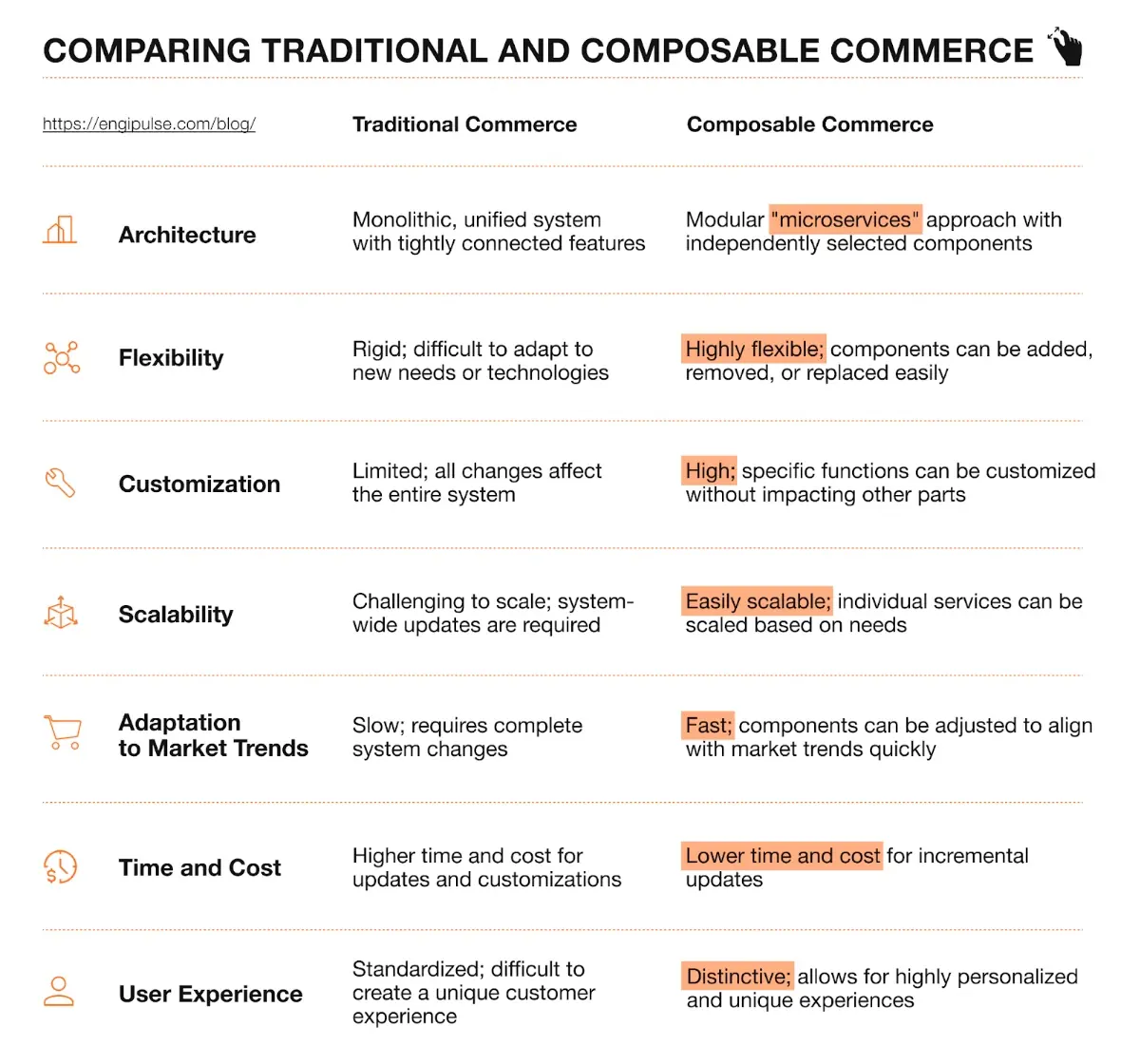
The primary distinction between traditional and composable commerce is that the latter is more flexible, scalable, and adaptive. Traditional commerce platforms are monolithic, built as an integral part of one unified system. Their features are tightly connected and typically include product catalogs, checkout, and payment processing. The system, though complete in itself, is very rigid. It’s quite hard to adapt it to either a new need or new technology. Businesses dealing with traditional commerce find it hard to customize because even minor changes impact the whole system. This translates into cost and time, as every customization or update requires changes across the entire platform.
On the other hand, composable commerce allows a business to select various components, including content management, payment gateways, and inventory management. You can choose a vendor or even develop your own solution. These components, the so-called “microservices” interact with each other through APIs to allow companies to mix and match solutions. The flexibility is so substantial that businesses can go ahead and create a highly customized e-commerce experience, adding or replacing functions. Rest assured, as your business grows and customer demands evolve, the need to customize your e-commerce platform will become essential. Composable commerce allows for more innovation, much quicker adaptation to market trends, and a distinctive user experience.
Composable Commerce Benefits
Data shows that 72% of retailers have already adopted a composable approach to commerce, and it becomes evident that this solution is gaining traction. But why exactly is it so revolutionary?
- Customization for Unique Business Needs.
Composable commerce is based on a microservices architecture; each “service” or module can be customized for particular business operational needs. For example, luxury fashion brands leverage extended Product Information Management (PIM) and Digital Asset Management (DAM) that support high-quality images, AR try-ons, or even 3D product models. As a result, these brands offer a more immersive shopping experience than traditional platforms.
- Agility in the Adoption of New Trends and Technologies
With composable commerce, businesses can embed state-of-the-art technologies into specific capabilities without overhauling the entire system. For instance, they might integrate a headless CMS for content delivery or an AI-driven recommendation engine into their existing setup. Some retailers might want to add a Conversational Commerce feature — an AI-driven chatbot to their website. This decision will drive customer engagement without necessarily having to introduce significant changes to the back-end functionality or even the architecture of your system.
- Scalability of Business Growth
Composable commerce is API-first, meaning each service can be scaled independently. As such, a fitness subscription could auto-scale cloud services for their video streaming module alone and not have to scale parts of the platform that aren’t in heavy use.
- Cost-Efficiency in Development and Upgrades
With the rebuild of only certain services, organizations save on full-platform rebuild costs. For instance, an international e-commerce website wants to replace its current payment handler with another that offers multicurrency and is PCI-compliant. They can easily do that using composable commerce by simply replacing the payment component without disturbing their product catalog. This way, it saves money and speeds up the transition.
- Improved Time to Market with Solutions Already Integrated
Many composable commerce platforms have out-of-the-box integrations for third-party services. A seasonal e-commerce company with a mere pre-configured integration to a Content Delivery Network (CDN) can add pages or promotion content fast, which ensures that new launches are well-timed as peak shopping periods hit.
- Improved User Experience with Personalization
Businesses can integrate best-in-class Customer Data Platforms (CDPs) and Personalization Engines to power deep analysis and real-time use of data, enabling personalization at scale. An online bookstore, for example, can apply advanced behavioral targeting to build dynamic landing pages, boosting relevance with each returning visitor to ensure better conversion rates.
- Future-Proofing Against Industry Changes
Composable commerce enables companies to promptly integrate industry-specific tools. If the system is API-driven, a retailer could add a sustainable supply chain API to display in real-time the carbon footprint information. Customers demand to have full information about products these days, so having such an API will boost customer satisfaction.
- Seamless Integrations with Existing Enterprise Systems
Most composable commerce solutions seamlessly connect to ERP and CRM systems. This means you have a single view of the customer and inventory in one place. For instance, a B2B company can integrate its composable commerce platform with Microsoft Dynamics 365. This integration provides sales representatives with real-time information on orders placed by each customer, accelerating customer service.
What’s the difference between composable commerce and headless commerce?
Both composable and headless commerce are modern approaches to building e-commerce platforms, each with unique benefits. Technically, headless is the first step toward composable commerce. Headless commerce gives companies the ability to develop custom front end for various devices, including mobile apps and websites. It is made possible by decoupling the front-end, which is the customer-facing interface, from the back-end, which manages inventory, checkout, etc. As a result, you get more creative freedom and much smoother integrations across an array of diversified touchpoints.
Composable commerce builds on this foundation by modularizing not only the front and back ends but also each core function. Key functions like payment processing, product search, and customer reviews are separated into distinct components, or “microservices.” This is an evolution in that companies can now craft hyper-personalized platforms by selecting best-in-class services and adjusting individual components. And all this without limits! Being more scalable and flexible, composable commerce is a logical step after adopting headless.
Challenges of Composable Commerce
Although the benefits of composable commerce are self-explanatory, each organization planning to incorporate a technology or approach that will change its operation needs to consider potential challenges. Here’s the list of things you need to be ready for:
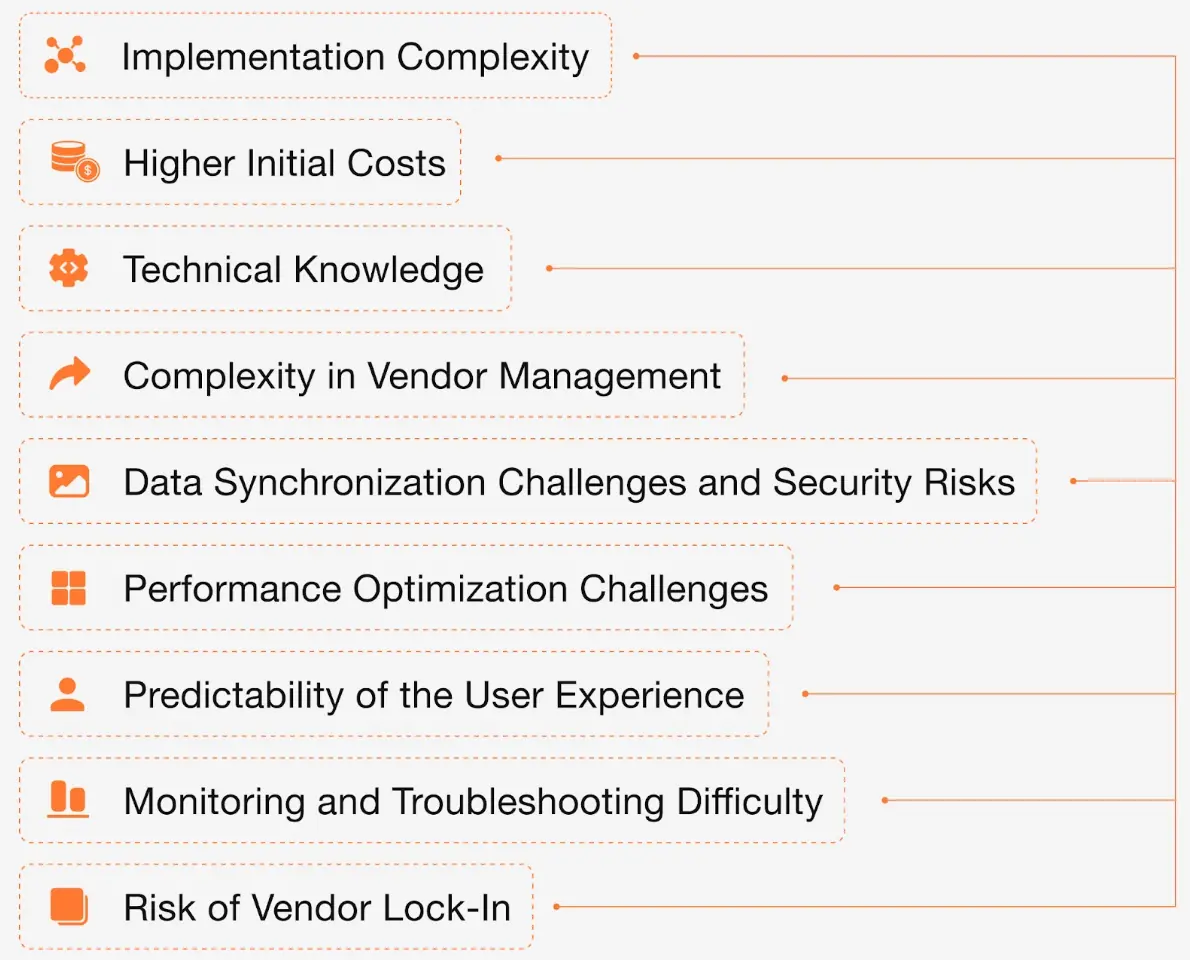
- Implementation Complexity. Composable commerce has high architectural complexity due to the integration of many microservices. This is why the process needs careful planning to ensure everything works in harmony. How to overcome it? Prioritize hiring seasoned system architects to plan and manage the integration process and create a thorough implementation roadmap.
- Higher Initial Costs. Because of the licensing costs for separate components and the requirement for specialist integration work, the initial investment may be substantial. How to overcome it? To prove ROI and gradually support additional investments, start with high-impact areas like checkout or payment systems.
- Technical Knowledge. You’ll need a highly qualified development team with API, microservice, and cloud experience. Assembling such a team might require additional time and resources. How to overcome it? To guarantee seamless integration and management, either work with a specialized development agency or invest in upskilling your current staff.
- Complexity in Vendor Management. With several service providers, strong vendor management is necessary to keep updates, support, and component compatibility intact. How to overcome it? To maintain provider compatibility, upgrades, and communication, assign a specialized staff or use vendor management software.
- Data Synchronization Challenges and Security Risks. Maintaining consistency of data among the services can be challenging. Multiple points of integration, if not properly managed, can result in security risks. How to overcome it? To reduce risks, use centralized data orchestration technologies and make sure security regulations like PCI DSS and GDPR are followed.
- Performance Optimization Challenges. Latency can occur when multiple services make API requests to each other. More advanced monitoring and control of APIs are required for improved performance. How to overcome it? Reduce latency and preserve flawless user experiences by utilizing caching techniques, API gateways, and performance monitoring tools.
- Predictability of the User Experience. Because separate services can behave differently and update independently of one another, it becomes considerably harder to ensure predictability in the user experience. How to overcome it? Create a solid design framework and carry out exhaustive testing to guarantee uniform behavior across all touchpoints and services.
- Monitoring and Troubleshooting Difficulty. Having many different services makes it difficult to identify and troubleshoot problems. This issue necessitates the use of end-to-end monitoring tools to ensure system health. How to overcome it? Use end-to-end observability tools, such as Datadog or New Relic, to monitor system health and spot bottlenecks fast.
Risk of Vendor Lock-In. Flexibility may be limited if essential services are reliant on specific vendors, making it challenging to switch vendors later on. How to overcome it? Select open-standard vendors and make sure the architecture of your platform makes it simple to swap out specific services when necessary.
At Engipulse, we prioritize transparency and value-driven partnership. That’s why, our cooperation models are designed in a way that allows our clients to retain core expertise and avoid vendor lock-in.
Is Composable Right for Your Business?
Change is something many decision-makers are reluctant to accept. Uncertainty, high costs, and undertrained staff are the primary factors that prevent organizations from fully embracing it. However, change doesn’t always have to be super challenging. The good news is that with composable commerce, organizations don’t have to adopt the “all-or-nothing approach”. To reduce the high upfront costs associated with replacing legacy architecture with composable features, you might begin with a step-by-step approach. Start by determining which short-term objectives will have the greatest influence on your company.
For example, a company could begin with a focused improvement in the checkout and payment process rather than updating the entire system at once. A modern, flexible payment system might decrease cart abandonment, increase checkout time, and expand payment options. Because they affect the user experience and are the low-hanging fruit that can yield immediate benefits, these features are an excellent place to start. They will also demonstrate ROI to make it easier to justify further composable upgrades.
But how can you tell if composable commerce is the right move right now? Or could it be that the stars haven’t aligned just yet? Here’s the list of questions for all transformation leaders contemplating adopting composable:
- Can our current platform support rapid shifts in customer demands and new technologies, or would composable commerce enable faster adaptation?
- Is our current platform scalable enough for future growth, or will modular components help us scale only what we need when we need it?
- Will our team be able to maintain and integrate multiple microservices, or do we need more resources?
- Can we upgrade only certain modules with composable commerce to save on long-term expenses, or is the initial setup cost higher than we can afford?
- Are we trying to provide unique and personalized experiences that are difficult for conventional systems to support?
- How will composable commerce impact our bottom-line customer satisfaction, operational effectiveness, and conversion rates?
If the answer to all these questions is “yes”, composable isn’t something you can put away anymore.
How to Choose the Best Composable Commerce Platform?
1. Alignment with Strategic Business Objectives
A great composable platform needs to unlock a wide range of e-commerce objectives, such as scalability and the capability to drive hyper-personalization. It should allow companies to deploy only necessary components such as conversion rate optimization (CRO), customer lifetime value (CLV), and seamless omnichannel experiences. In simple words, your platform of choice needs to have functionality to scale according to your business strategic direction.
2. Big Modular Microservices Ecosystem
A strong ecosystem of modular microservices is a must for key functions such as checkout flows, PIM, OMS, personalization engines, and AI-driven recommendation systems. Each of the microservices should be independently operable and of a plug-and-play nature. This will allow you to add, replace, or upgrade certain services without impacting the rest of the platform.
3. API-First Architecture with Advanced Integration Support
API-first is an important feature of composable commerce. RESTful and GraphQL APIs should be fully documented, highly scalable, and with low latency to integrate enterprise systems like ERP-SAP, Oracle, CRM-like Salesforce, and Microsoft Dynamics, along with specialized third-party apps. Prebuilt connectors ensure real-time synchronization of data between services through webhooks.
4. High Customization and Flexibility through Headless Commerce
Fundamentally, a composable platform should provide the next level of customization via headless commerce capabilities. Decoupling the front from the back enables Progressive Web Apps, Single Page Applications, or other modern frameworks like React, Vue, or Angular to build seamless, branded experiences across all devices. This level of flexibility empowers businesses to be in continuous iteration over UX and to differentiate through custom design and functionality.
5. Scalability and Performance Optimization
Scalability is not an option but a necessity. The platform should be cloud-native, preferably on auto-scaling provided by AWS Lambda, Google Cloud Functions, or Microsoft Azure. Caching techniques, edge computing, and content delivery network (CDN) integration are examples of performance optimizations that should provide low latency and dependable load handling during traffic surges. Everything needs to help maintain a flawless user experience even during busy times.
6. Enterprise-Grade Security and Compliance Protocols
Security consists of rigorous protocols, including TLS encryption, OAuth 2.0, PCI DSS for safe transactions, and GDPR/CCPA for data privacy. The best platforms will have identity management systems such as Okta and Auth0 that ensure customer information is safe.
7. Strong Vendor Support and Partner Ecosystem
The platform should have full vendor support operating 24/7 with proactive monitoring. An ecosystem of certified partners and pre-configured integrations like digital asset management (DAM), search and navigation (e.g., Algolia, ElasticSearch), and marketing automation (e.g., HubSpot, Klaviyo) reduces friction in onboarding and minimizes overhead.
8. Clearly Explained Total Cost of Ownership (TCO) and Cost Efficiency
A composable platform should cover a TCO, including license fees, integration, maintenance, and upgrade costs. Subscription-based pricing and modular billing make it possible to budget affordably, paying only for the selected components. Updates should be nondisruptive; they should occur in the background to prevent unexpected downtime and reduce overall maintenance costs.
9. Case Studies and Industry Validation-Demonstrated Track Record
Look for a platform that has had proven success in similar verticals. In-depth case studies, industry awards, and testimonials in related verticals like fashion, B2B wholesale, or health and wellness will give further understanding of the platform’s real-world outcomes. Success stories proving increased average order value (AOV), higher conversion rates, and reduced time to market will validate the platform’s ROI and business impact.
Bottom Line
Composable commerce solutions are an excellent way to boost customer engagement. With clients nowadays seeking experiences that go beyond the ordinary, this change will inevitably revolutionize your product’s market positioning. One key reason for adopting composable commerce is to enhance customer experience, with 22% of organizations citing this as a primary motivation.
If you’re a strong believer that all good things come through hard work and new initiatives, adopting composable commerce software is the next step in building an agile, customer-focused product.