
Hyper-personalization in Retail: What Is It and Why Does It Matter?
Business
14/07/25
Read time: 18 min

Introduction:
Remember the days when walking into a brick-and-mortar store was like a game of roulette? You might have a pleasant experience, or a grumpy salesperson could sour your mood by ignoring you or sighing heavily. While this used to be the norm—and people would often still buy from the brand—businesses today can no longer afford such poor treatment. Now, companies are actively seeking ways to enhance customer experiences, and one of the most effective methods, backed by both data and common sense, is hyper-personalization. Initially powered by human resources only, personalization has moved to being technology-driven, especially when it comes to online experiences. According to a December 2024 Bolt poll, more than 70% of US digital retailers think genAI and AI-driven personalization would impact their business in 2025, making hyper-personalization just as crucial as omnichannel.
With this in mind, let’s delve deeper into this exciting trend to understand how exactly a business can implement hyper-personalization to its advantage. After all, knowledge is power, so let’s find out how you can personalize like a pro.
What is hyper-personalization in retail?
To kick off, let’s begin with a hyper-personalization definition. According to Deloitte, it is the most cutting-edge technique for brands to customize their marketing to specific consumers. Hyper-personalization is accomplished by using data, analytics, AI, and automation to create personalized and targeted experiences. Businesses can use hyper-personalization to provide highly contextualized messages to particular clients via the appropriate channel, time, and location.
Traditional personalization vs. hyper-personalization
Traditional personalization has been around for years; frankly speaking – it’s been pretty effective. By using simple data points, brands can make decisions and provide a personalized experience. For example, a sportswear brand might offer discounts on running shoes to customers who previously bought similar products. This strategy can be effective – after all, old sneakers may have worn out, so a discount on a new pair seems like a great deal, doesn’t it?
However, this way of thinking is quite limited. A brand seeking to provide hyper-personalized service needs to ask itself deeper questions: How can we understand the customer’s unique preferences and habits? What data can we leverage to offer not only a discount but also a recommendation that aligns perfectly with their lifestyle and current needs? And if a customer’s lifestyle has changed – perhaps they’ve shifted from running to hiking – how can we ensure we’re offering a pair that suits their new activities?
Other examples of personalization include:
- email marketing with name personalization;
- location-based offers;
- birthday discounts and offers;
- targeted ads based on previous purchases;
- loyalty program rewards.
On the other hand, hyper-personalization in retail is a game changer. Many industry giants have already mined the gold of hyper-personalization, leveraging it to create truly tailored experiences that keep customers coming back. Nike, for example, has a 3D sneaker customization platform, where all users can fully customize shoes to fit their preferences and lifestyle. Tesla has taken it a step further. The car brand remembers each driver’s preferred sitting position, mirrors, steering wheel position, radio presets, and even their driving style. All this data helps them build cars that function as a literal extension of the driver, adapting to their preferences for a truly customized driving experience.
All these approaches improve customer retention and boost revenue. Why? Because buyers feel valued and seen, forging a connection that turns casual shoppers into devoted fans.
Hyper-personalization vs. segmentation
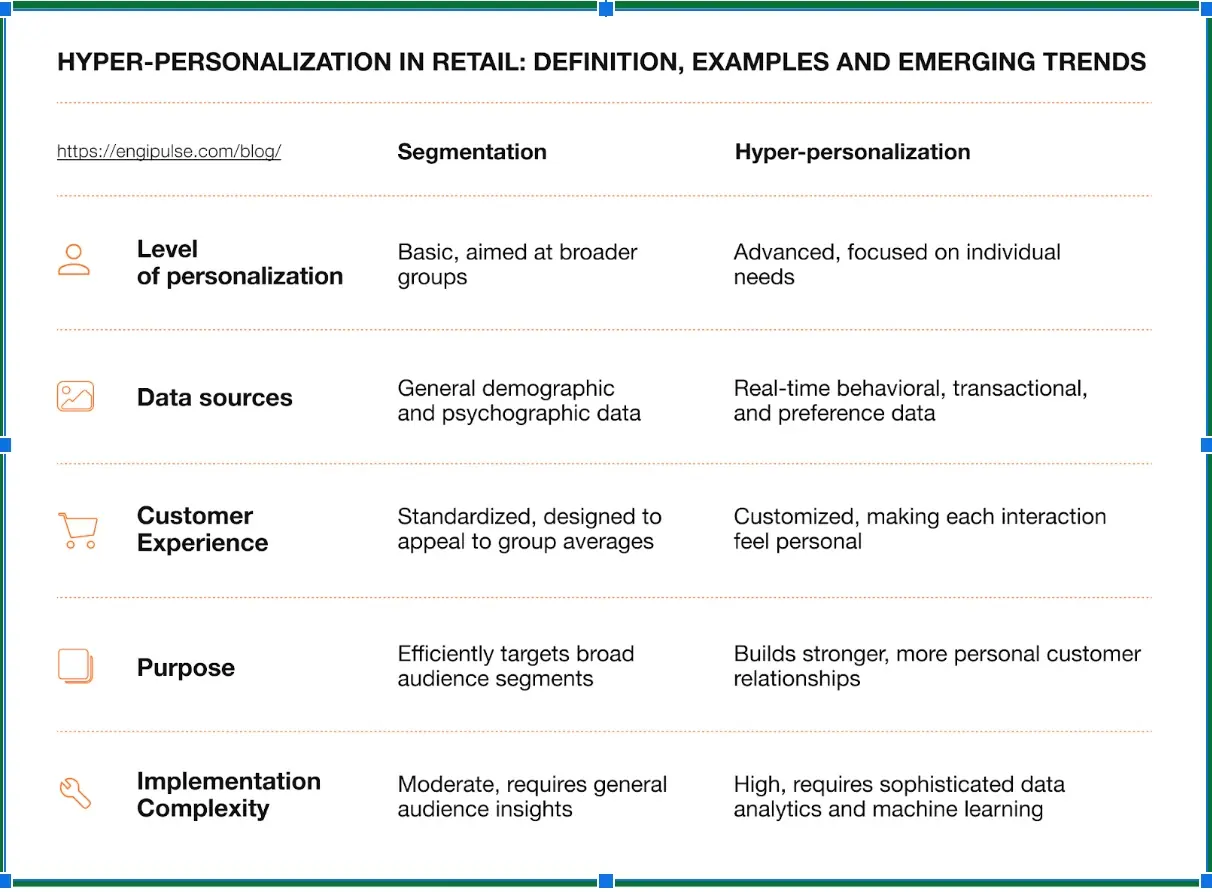
Let’s start with a widespread misconception. Although they sound similar, customer segmentation and hyper-personalization are different. Consider it this way:
Segmentation is like preparing a large meal using a generic approach to suit the tastes of many. It makes use of general ingredients that “may” work for the majority of people. For example, a group of people visit a restaurant where pasta with tomato sauce is served. It is assumed that the majority of individuals will favor this dish. Undoubtedly, segmentation saves time, but because it assumes that entire market categories have the same requirements and preferences, it is only the beginning of customizing.
However, hyper-personalization is like a chef cooking a special meal for a very specific person, considering their preferences and food allergies. By adopting this level of personalization, a restaurant enhances the dining experience because the customer feels taken care of. The same is true in retail, where hyper-personalization uses data insights to craft experiences that are specifically personalized to each customer, giving them a sense of value and belonging.
Important personalization statistics in retail
- Businesses with superior personalized service make 40% more money from those activities than do average players.
- Additionally, 71% of consumers expect personalization, and 76% report frustration when it’s lacking.
- Nearly 62% of shoppers say they’ll look elsewhere if a brand doesn’t provide a personalized experience. This essentially means that failing to know your customers leads to poor customer loyalty.
- Although consumers want to hear from brands, 58% of them claim that inconsistent or generic marketing irritates them.
- Personalization increases business growth rates by 6–10% on average.
- Personalization may boost revenues by 5 to 15 percent, lower acquisition expenses by up to 50 percent, and improve marketing spending efficiency by 10 percent.
Technologies that enable personalization in retail
Needless to say, all these miracles aren’t made possible by people only. Without technologies like ML, AI, IoT, and Big data, brands wouldn’t be able to provide unique experiences that resonate.
Machine Learning & Generative AI
ML and Generative AI reshape customer experience with intelligent use of data. At the core, ML algorithms can analyze massive datasets of user interactions, purchase histories, browsing patterns, and many more. Unlike traditional ways, ML uncovers intricate patterns that reveal each individual’s preferences and form a bedrock for highly tailored customer experiences.
Predictive modeling using ML takes this one step further by anticipating what customers might need before they realize it. By understanding behavior patterns, such models allow brands to tailor recommendations and provide offers at the exact moment when that customer is most receptive. The experience becomes “just for you” and “at the right time”. Moreover, ML makes hyper-personalization highly dynamic. It processes data in real time, helping brands change content or product recommendations on the spot after every new customer interaction.
Generative AI adds another powerful layer. It creates customized content, from personalized emails to custom-written product descriptions and unique visuals that speak to a person’s tastes. Generative AI also provides a deep contextual understanding of the user. It aligns content with each specific situation like best time of day, location, or recent behavior. Responsiveness to context provides the “human touch,” as if the brand does understand and anticipate each customer’s needs.
It also extends into customer service via the use of Generative AI-driven chatbots and virtual assistants. These remember customer histories and preferences to make personalized help quicker, more intuitive, and far more satisfying. Mixing real-time adaptability, predictive insights, and unique content creation, ML and Generative AI raise hyper-personalization beyond a mere improvement.
Big Data
Big Data recognizes patterns and trends, showing underlying customer preferences. Among other things, brands can predict what a client might need or want before the customer is completely aware of it by looking at browsing patterns, purchase frequency, and preferred channels. Big Data enables predictive analytics to power personalized product recommendations, targeted offers, and customized messaging. For example, a regular workout equipment shopper gets an email on the newest styles of sportswear that perfectly match their hobbies and prior habits.
Beyond preference, Big Data enables personalization in real time. As customers interact with a brand’s digital touchpoints, such as a website, app, or chatbot, Big Data analytics work across touchpoints instantly. They change what is being served up or recommended based on what customers are currently doing. This ability to respond at the moment creates a dynamic experience that can feel truly individualized. Whether it is a booking website showing products in the customer’s size or a streaming service making recommendations for a new series based on recent viewing habits – Big Data is the backbone.
The technology also allows brands to add contextual features to the customer experience. These can range from location-based to weather or time-of-day options. Imagine a fitness brand that, based on a customer’s past purchases, workout habits, and current location, sends a notification suggesting a new running shoe model designed for trail running. They do that just as the customer arrives at a popular hiking spot. Plus, it even offers a nearby location for purchase or instant delivery options based on real-time weather conditions. This level of hyper-personalization goes beyond generic location-based offers. It shows customers that the brand understands their unique needs and current context, fostering a deeper sense of loyalty.
Augmented Reality & Virtual Reality
AR and VR allow shoppers to virtually try on items, providing an unprecedented shopping experience and putting the “try before you buy” philosophy into practice. Customers can see how items such as accessories, clothing, or makeup look on them. And the best thing is that they can do it from the comfort of their homes! This reduces the number of returns and improves customer satisfaction. Turns out well-informed judgments are changing the shopping experience!
ModiFace is an AR and AI-powered platform that was acquired by L’Oréal. It empowers the customer to engage with ModiFace-optimized beauty experiences on their device-from skin care analysis to virtual hair color. They can ‘try on’ lipsticks, foundation shades, eyeshadows, or hair colors to get a view of what each might look like based on unique features and skin tone. The experience is just about as real as trying on an outfit in a live store.
These virtual try-ons blend the visual fidelity of AR with data-driven recommendations of AI. As a result, your customers get an experience that feels tailor-made. This hyper-personalized approach means enabling online shopping that rivals the in-store benefits.
Computer Vision and IoT
Computer Vision is a field of AI that enables machines to interpret and analyze visual data. It has a major role in hyper-personalization across several industries. In retail, the use of Computer Vision powers image-based search and product recognition. This is a feature that uses the camera to enable customers to take a photo and instantly get similar items. This makes shopping seamless, intuitive, and tailored to each user’s preferences.
Besides search, Computer Vision plays a significant role in virtual try-ons, enhancing how items such as clothing or makeup look on users via their devices with greater accuracy and realism. By analyzing facial features or body measurements in real time, the system offers a more personalized “try-before-you-buy” experience. Computer vision assists in monitoring foot traffic patterns and in-store activity in brick-and-mortar retail settings. It offers brands vital information about the consumer. This technology closes the loop between the digital and physical shopping worlds by using visual engagement.
IoT takes hyper-personalization to the next level. It uses real-time data from smart devices like wearables, home assistants, and fitness trackers. While the smart fridge analyzes what food is left inside and offers opportunities for replenishment on frequently used items, smartwatches might allow a fitness brand to offer recovery products based on data about one’s last hardest workout. All these approaches enable the ultimate level of personalization.
The benefits of hyper-personalization in retail
According to 88% of marketers, the main reason to invest in personalization is to enhance the customer experience. Now, although customer satisfaction and loyalty are major benefits in and of themselves, let’s consider other advantages of this approach.
- Increased NPS (Net Promoter Score). With hyper-personalization, customers feel valued and understood. Thus, this creates a memorable experience that generates loyalty. This advantage has a direct effect on NPS since consumers are more willing to recommend brands offering uniquely fitted interactions to them.
- Improved CLV (Customer Lifetime Value). Hyper-personalization offers customers timely deals and continuous communication to nurture relationships with them. Such frequent engagements stimulate purchases, increasing the CLV for each customer and creating more loyal customers over time.
- More Revenue, Higher Conversions. While applying data-driven insights, hyper-personalization delivers product recommendations, targeted discounts, and relevant content to every customer’s liking. This precision converts into more buys and higher conversion rates, leading to revenue growth. In fact, the financial impact of personalization is highlighted by Bain & Co.’s study on “The Economics of E Loyalty,” which shows that a modest 5% improvement in customer retention can result in a significant rise in earnings, ranging from 25% to 95%.
- Reduced Customer Churn. When brands can proactively address the needs of every customer, they improve satisfaction and loyalty. This type of hyper-personalization keeps away any potential for churn since an always-relevant experience reduces the likelihood of customers looking elsewhere.
Implementing hyper-personalization in retail
Hyper-personalization in retail is a strategic process that combines data collection, advanced technology, and customer-centered processes. General steps for implementing it include:
- Data Collection. Collect data from all touchpoints in buying history, browsing behaviors, social media communications, and even IoT devices. Combine these individual points of data into one system to get a holistic view of each customer.
- Leverage AI and ML. Use AI and machine learning algorithms to identify patterns from the data. These technologies make predictive modeling possible to anticipate customer needs and offer personalized recommendations, content, and offers.
- Put in Place Real-Time Personalization Tools. Deploy tools that would offer real-time personalization, product recommendations, or messaging based on what a customer is doing at that very moment. For example, Adobe Target and Dynamic Yield are using ML to personalize content and product recommendations on websites and mobile apps. Optimove and Braze specialize in real-time customer messaging across email, SMS, and in-app notifications. These tools make every engagement more relevant and impactful by delivering a tailored experience in that key moment.
- Use Omnichannel Touchpoints. Make sure hyper-personalized experiences are implemented seamlessly across online, in-store, and mobile touchpoints. Such personalization enables customers to enjoy frictionless and contextual interactions with a brand wherever they interact.
- Incorporate Feedback Loops. Collect customer feedback and track key metrics on engagement for refining personalization. What resonates with customers, for sure, will help the brands fine-tune an approach to improve future interactions.
- Focus on Privacy and Transparency. Since hyper-personalization is data-intensive, brands need to be aware of data privacy and transparency. Your clients must understand the use of their data. Give people the choice to opt in or out based on their privacy preferences.
At Engipulse, we prioritize transparency and value-driven partnership. That’s why, our cooperation models are designed in a way that allows our clients to retain core expertise and ensure their customers enjoy extraordinary experiences.
Emerging trends of hyper-personalization in retail
Social media personalization is one of the most common trends in retail. Given the scale at which Instagram, TikTok, and Facebook are gaining user data, it is now easy for retailers to show hyper-personalized ads and content to users matching their interests, behaviors, and social interactions. For example, marketers can send advertisements or posts based on a user’s recent interactions with a competitor. This approach makes the social media experience even more interactive and relevant.
Another emerging trend is personalization which goes beyond product recommendations. Though recommendations remain important, modern hyper-personalization is about the entire customer journey. From customized in-store experience to adaptive website layouts, everything can be adapted to fit the needs of a target user.
Customers today are more concerned about privacy, thus ethical and open personalization is crucial. Brands have begun to focus on transparent personalization, enabling complete transparency about how customer data is used and the ways customers can be in control of their choice of privacy. The road to trust is built when customers are confident that their data is used responsibly and ethically.
Conclusion
The article has emphasized how important it is to provide a highly personalized customer experience in 2024, but if you’re not convinced yet, imagine yourself in your customers’ shoes. With prices rising across the board, today’s shoppers aren’t just looking to buy—they’re looking for quality, attention, and memorable, one-of-a-kind experiences that make each purchase feel truly special.
With 89% of companies already investing in hyper-personalization, your business just can’t afford to fall behind. Our final advice: stock up on ingenuity, treat each customer as an individual rather than part of a group, and steadily work towards becoming exceptional. Your customers will love it!