
Retail AI Revolution: Case Studies Driving 2025 Success
Business
16/07/25
Read time: 12 min

Artificial intelligence is now an invisible conductor in charge of every facet of contemporary retail, not just the shiny toy in the toy box. It is anticipated that worldwide retail AI spending will increase at a rapid 23% CAGR, surpassing the growth of other line items on the CFO’s spreadsheet, from approximately US$11 billion in 2024 to over US$40 billion by 2030. According to McKinsey, generative and predictive models could generate between US$240 billion and US$390 billion in value annually, or up to 1.9 percentage points of profit margin for the industry. This is hardly insignificant when you think about the difference between staying ahead of the competition.
AI provides retailer-specific promos that make anonymous consumers feel like VIPs, eliminates wasteful supply chain fat and inventory movements, and relieves staff of mundane tasks so they can serve customers with joy. In short, AI raises revenue, cuts waste, and transforms clunky workflows into choreographed performance, while still preserving humanity at checkout.
Audentes fortuna iuvat – fortune smiles on the bold.
Why AI now? The Retail Imperative
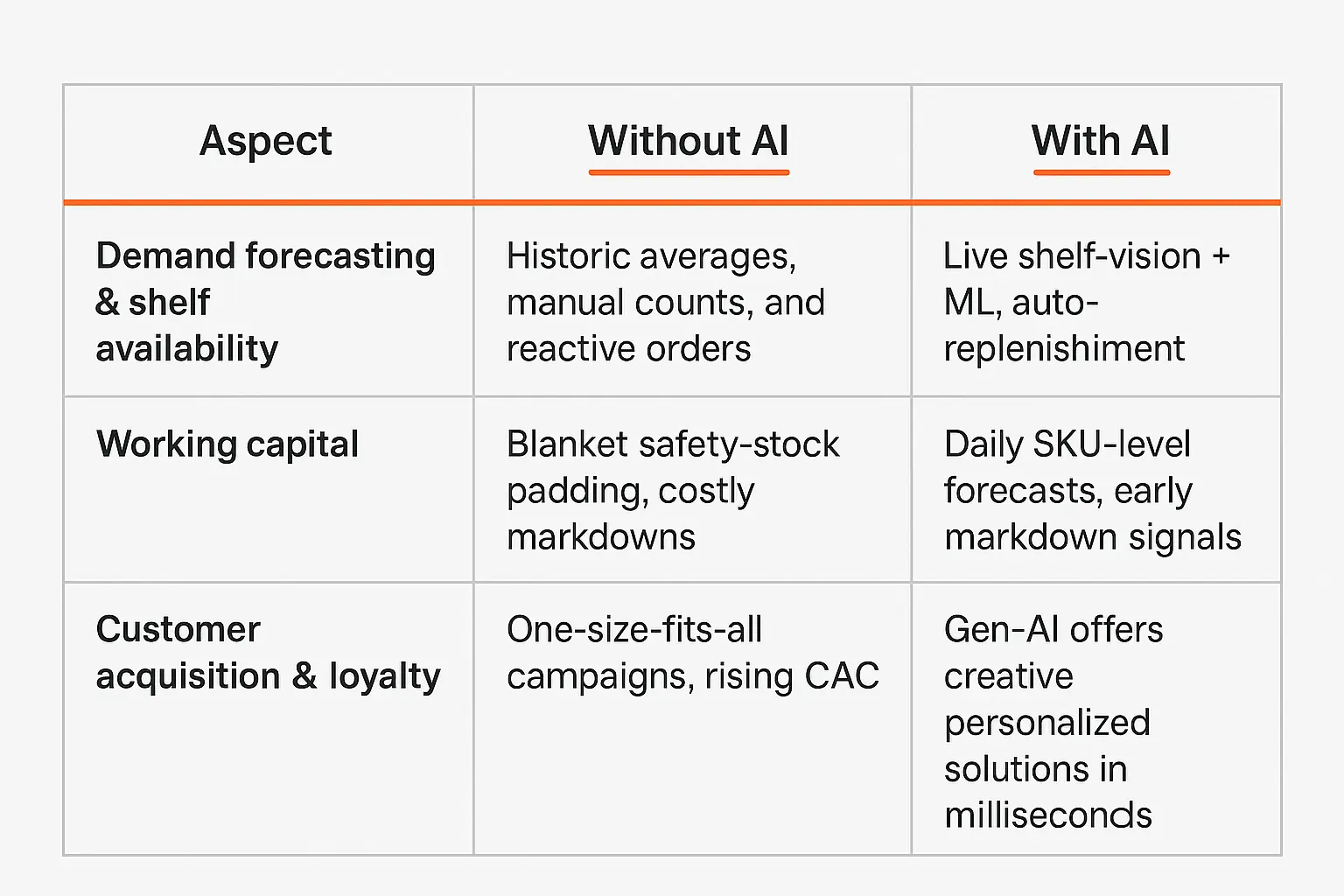
You can feel the pressure when you walk into an average store: customers demand individualized offers and shelves that stock themselves, while prices are going up everywhere. Spreadsheets can’t keep up with AI, which allows a deluge of data to be converted into decisions in a matter of seconds, keeping customers coming back and products going forward. Essentially, integrating AI into your omnichannel retail strategy is now imperative to staying relevant and should not be considered a side project.
Key benefits
- Sharper demand signals. Retailers who use AI-driven inventory systems report fewer stock-outs, which results in happier shelves (and customers) and more acute demand signals.
- Reduced working capital. Machine-learning demand forecasting can cut prediction errors by up to 50%, which lowers the cost of keeping inventory by 20% to 30% and frees up working capital for expansion.
- Increased loyalty at reduced CAC. Hyper-personalized offers that are generated in milliseconds increase click-to-purchase rates and reduce marketing waste, which feeds a positive feedback loop that increases relevance and revenue.
Read also: Agentic AI 2025: Types, Use Cases, Industries, and More
Brands Proving AI Isn’t Just Hype
Theory is good, but code in production is what makes cash registers ring. The stories that follow demonstrate how top retailers have transformed algorithms into everyday advantages by bringing AI from the lab to the balance sheet.
ASOS
For ASOS’s recommendations to appear curated rather than random, each of the 85,000 products it sells must be categorized by cut, color, texture, and trend. Experts at ASOS developed a multilayer neural network to make this work possible. It embeds each product into a “style space,” which allows the model to create an entire outfit from a single seed product—a capability that was previously only possible for human stylists. According to ASOS data scientist Elaine Bettaney, “each item needs to work with all the others for the outfit to work.”
Business is what algorithms are all about. These AI and AR in retail tools demonstrate how ASOS brought innovation from the lab to the checkout counter, which is why the company’s profits jumped 3 times.
- Virtual Photoshoots (“See My Fit”). Through a partnership with Zeekit, the brand maps new lines on 6 real-life models and creates 500 photoreal images a week, keeping the product fresh and dropping new lines, while studios were closed.
- Profile Builder. A clustering engine that allows shoppers to declare their style DNA and then curate their own storefront, driving large basket sizes and repeat visits.
- Style Match Visual Search. Press the camera icon in the search box, upload an outfit, and a computer-vision model searches 85,000 SKUs to find similar items in seconds – “a very welcome style guru,” as Business Insider described it.
- Fit Assistant. ML crunches height, weight, age, and past purchases to get the right size first time, reducing return rates.
- Demand and Logistics Predictive Analytics. AI forecasting reduces excess stock, optimises fulfilment, and was a fundamental driver of ASOS’s staggering 253% profit growth during the pandemic boom.
In addition to improving the user experience, ASOS’s visual searching, size intelligence, and predictive analytics inventory also generate real cash dividends. As a result of AI-led fit accuracy reducing returns and hyper-relevant styling tools encouraging more first-clicks into baskets, the retailer’s profit increased by 253% to £106 million for the half-year ending February 28, 2021. “Style Match” maximizes conversions by instantly turning any street-style photograph into a shoppable rail, while internal reporting websites show a measurable decrease in the underlying returns rate as a result of the Fit Assistant.
Under Armour
Under Armour partnered with Swedish Fit-Tech company Volumental to install self-service 3-D foot scanners at test locations because it wants customers to leave the store with shoes that fit them, not just in terms of size but also feel. In five seconds, the device creates a complete digital twin of each foot, which is then fed into the Volumental Fit EngineTM, which makes cross-references with:
- eleven precise measurements and shape attributes,
- construction data for every footwear SKU,
- purchase history from “shape-twin” shoppers, and
- live in-store inventory.
A customised “fit list” appears on a tablet, and the profile syncs to the customer’s Under Armour account, meaning they will have the same recommendation systems online or mobile. The end result is a service with no friction, more like an experience in a sports lab rather than in a shoe aisle.
What changed once the scanners went live?
| Metric | Before | After Fit Engine™ | Delta |
| In-store conversion rate | Baseline footwear average | +70% more shoppers convert | Up sharply |
| Transaction value | Standard ticket | +32.5% average basket size | Higher spend |
| Returns | Industry-typical misfit returns | -25% item returns | Waste down |
| Repeat purchases | Ordinary repeat rate | Customers who scan buy twice as often | Loyalty up |
Those improvements impact the P&L since they result in fewer markdowns, lower reverse logistics expenses, and more first-party data to boost Under Armour’s omnichannel marketing. In other words, a five-second scan can now perform the tasks of a skilled shoemaker, proving how astute AI can boost bottom-line performance in addition to client confidence.
Starbucks
Starbucks has 17 million rewards members, and 31% of U.S. orders are now placed through its mobile app, and each tap comes with location, weather, and basket information to feed into Deep Brew, Starbucks’ proprietary AI platform. Deep Brew powers the My Starbucks Barista voice bot, which remembers your “grande oat-milk flat white” regardless of which store you’re in, delivers time-of-day offers, and even alerts baristas who the next regular is before they hit the till. This AI personalization in retail resulted in a 30% increase in marketing ROI and double-digit engagement increases.
In order to reduce food waste by up to 15%, Deep Brew’s operational layers estimate demand, integrate point-of-sale (POS) sell-through data, and automate labor scheduling so that peak traffic is staffed without going overboard. The Atlas location-intelligence tool analyzes local revenue, foot traffic, and cannibalization risk at the network level to identify the best locations among Starbucks’ 38,000 locations worldwide. Starbucks released unsweetened Mango Green and Peachy Black iced teas since 43% of tea drinkers do not use sugar, according to the same data flywheel that drives quick menu R&D. Additionally, the timing of Frappuccino advertising was close to a heat-wave warning for Memphis.
Walmart

Managing the biggest physical supply chain in the world means that hundreds of shelves will be left empty if you make a mistake even 1% of the time. Walmart uses computer-vision cameras on each “high-velocity” aisle together with a demand-forecasting engine that takes into account local events, promotions, and weather in order to reduce that margin. The entire system is notified if something is missing, and it automatically creates a replenishment order upstream and pings adjacent colleagues. Stock-outs have decreased by 16% and on-time shelf fills have increased in the pilot stores since implementation.
The same AI brain powers distribution: predictive load-balancing is already moving freight to real-time regional demand, reducing CO2 and fuel costs, and removing an estimated thirty million unnecessary trucking miles annually. Better inventory for Walmart is both more sustainable and smarter, as seen by fewer empty hooks, lower shipping costs, and less food ending up in landfills.
Amazon
Each page is dynamically rebuilt by an item-to-item collaborative filtering engine that receives each scroll, click, and cart. It quickly rates billions of SKU relationships, then displays “Frequently bought together,” “Customers also bought,” and other rails that appear to be hand-picked rather than pre-programmed on screens, emails, and push notifications. These algorithmic nudges are not a side job; according to experts and other studies, they account for about a 29% sales increase to $12.83 billion during the second fiscal quarter of 2022, up from $9.9 billion during the same time last year.
The excitement is supported by performance data. Some on-site recommendation rows have conversion rates as high as 60%, dwarfing generic merchandising slots, according to Forrester data, which industry observers noted. The same engine also powers personalized email blasts and push notifications, and carefully chosen bundles and payday timing drive double-digit improvements in click-through and same-day revenue.
A product that is introduced at breakfast will appear in “Trending near you” by lunch because the model learns in real time. This keeps discovery as current as inventory and enables Amazon to maintain a minimal level of safety stock. In the end, artificial intelligence is not storefront décor. It is the storefront on Amazon.
IKEA
The IKEA Place/Kreativ app uses generative AI to remove any outdated furniture from your room and then inserts true-to-scale Billy bookcases or Friheten sofas with roughly 98% sizing accuracy. Seeing items in their own space increases confidence; researchers have found that customers who use the AR service have about 35% more online sales and 20–30% fewer returns.
The scan and design process also feeds IKEA’s demand engine, which helps shape the rollout of small stores with urban stock—that is, IKEA stuff that urban customers throw into their virtual rooms—and improve local stock estimates.
Engipulse’s Perspective
At Engipulse, we view AI as an accelerator rather than just a feature. Our custom AI solutions and retail software development experts integrate interactive augmented reality (AR) installation, real-time retail analytics, and machine learning pipelines into your website to make product discovery effortless, inventory flow during customer visits, and returns seamless. Whether you need a demand forecasting service to free up working capital or a visual search engine to turn street-style photos into shoppable SKUs, we design, develop, and integrate the tech stack so your teams can concentrate on expansion while the algorithms handle the laborious tasks.